Booth rent is the bill a nail tech owes whether the week was busy or dead — and whether the rent was worth paying is a per-service question. This tracker is written from the renter’s side of the chair: you pay booth rent to work in someone else’s salon, and it answers whether your services cover that rent profitably, service by service.
It is not a personal budget with a rent line in it — a household-budget framing is the Budget Hair Stylist Booth-Rent Budget Tracker’s job — and it is not a salon owner’s full bookkeeping system, which is the Salon & Spa Bookkeeping Spreadsheet’s job. This is one nail tech, one booth, and profit per service. (The mirror image — a shop collecting chair rent from its renters — is the Barbershop Chair-Rent Bookkeeping ledger; here, the rent flows the other way: you pay it.)
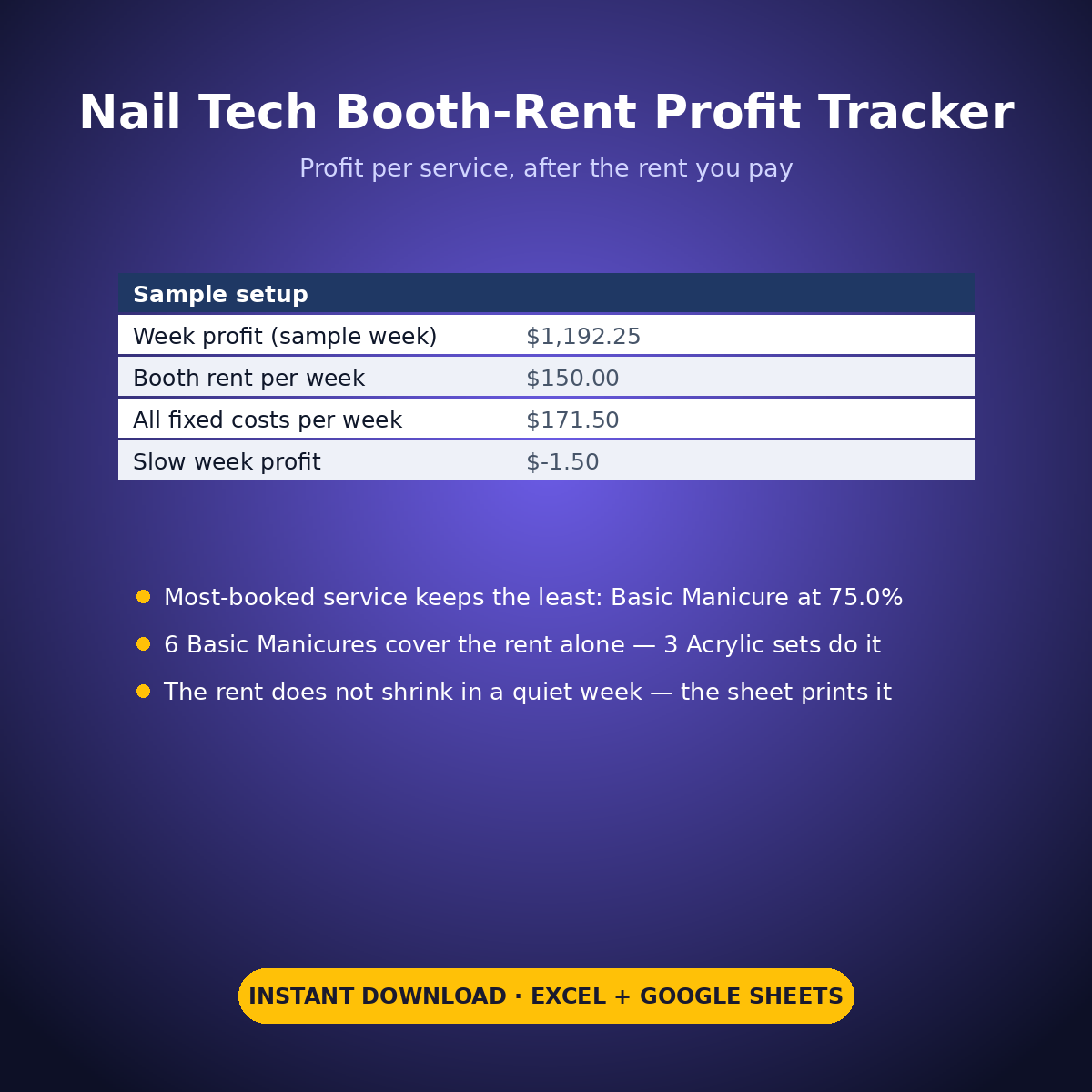
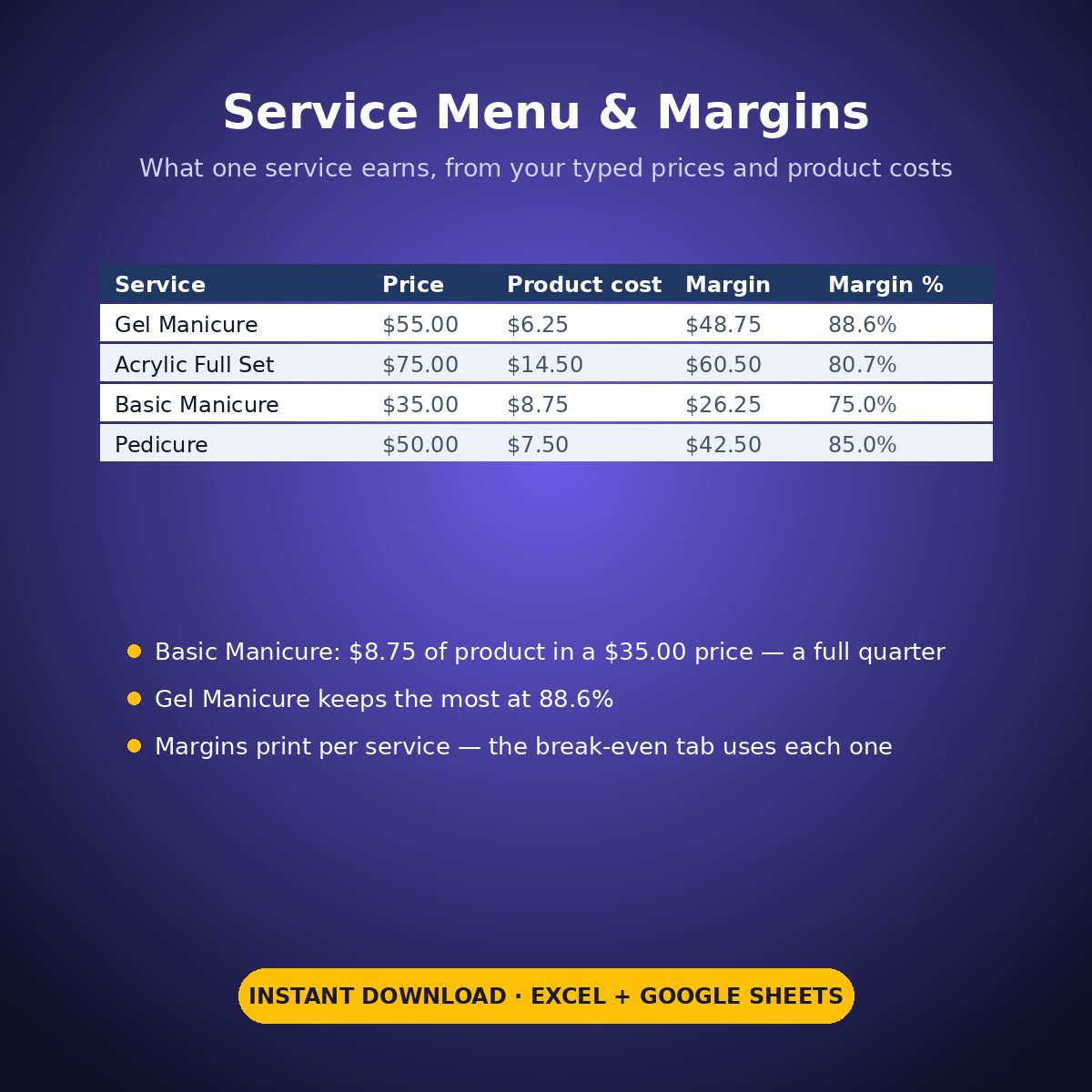
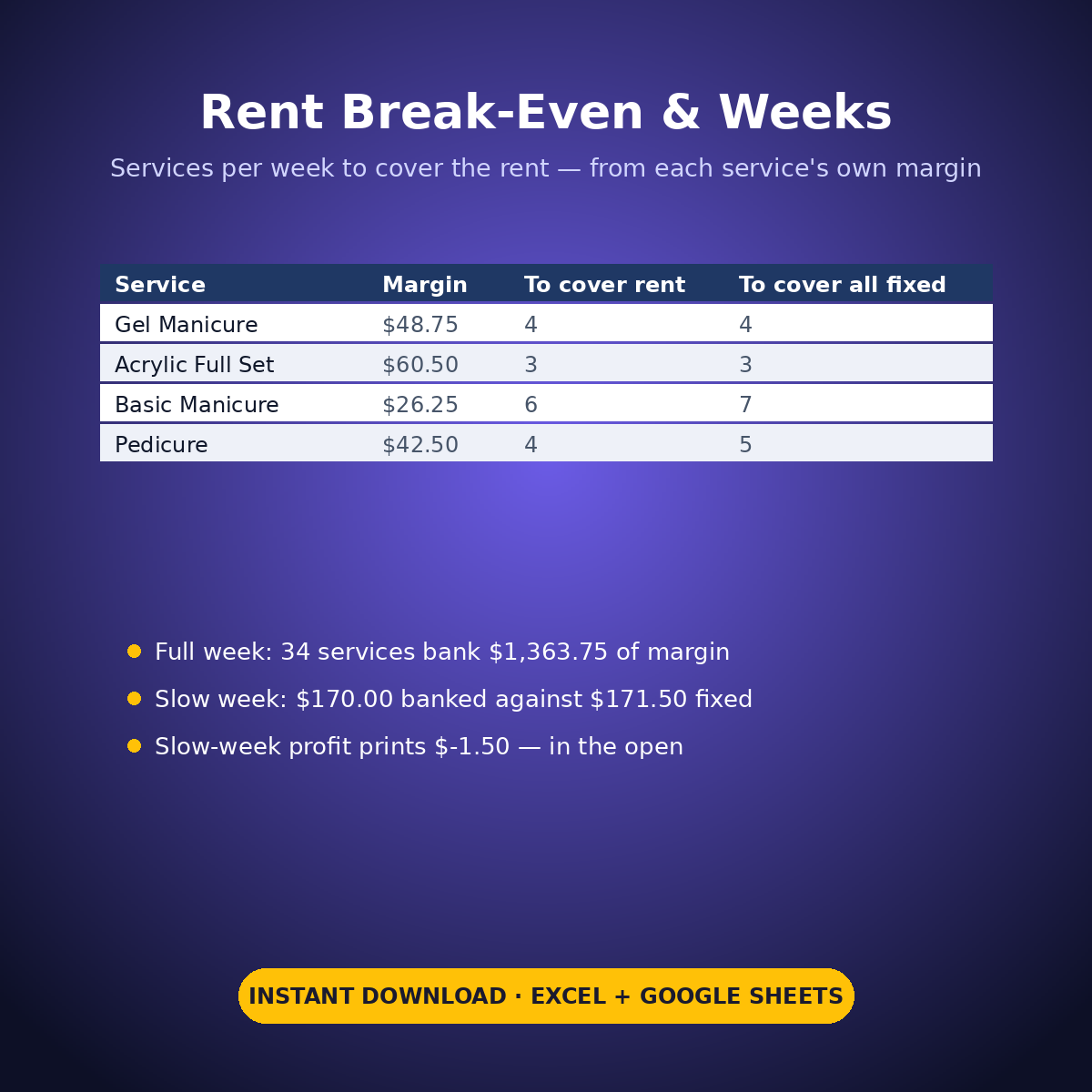
The sample menu makes the uncomfortable point plainly. The Gel Manicure keeps the most: $48.75 of its $55.00 price, 88.6%, because its product cost is only $6.25. The Basic Manicure keeps the least — $26.25, 75.0% — because its $8.75 product cost is a full quarter of its $35.00 price. And the Basic Manicure is the most-booked service in both sample weeks. Break-even prints per service against the typed $150.00 weekly booth rent: 6 Basic Manicures cover the rent alone, 7 cover all $171.50 of fixed costs — against 3 Acrylic Full Sets for the rent, because each one banks $60.50.
The full sample week does 34 services, banks $1,363.75 of margin and prints a week profit of $1,192.25 after the fixed costs. The slow week does 5 services, banks $170.00 against the same $171.50 — and prints a profit of -$1.50. The rent does not shrink in a quiet week, and the sheet does not smooth that over.
HOW IT WORKS
– ‘Service Menu & Margins’: one row per service — typed price and typed product cost per service. Margin per service and margin % calculate from your figures.
– ‘Rent Break-Even & Weeks’: the booth rent is pulled from Start Here; add your other weekly fixed costs. Break-even services per week print per service — to cover the rent alone, and to cover all fixed costs — each from that service’s own margin.
– The week checks: type the services done and the week’s gross margin, fixed costs and profit print. A second, slow-week check runs the same fixed costs against a quiet week.
WHAT’S INSIDE
– A per-service margin build: price minus product cost, margin % printed per service
– Booth-rent break-even per service, from each service’s own margin (sample: 6 Basic Manicures for the rent alone)
– A full-week profit check (sample: $1,192.25 after $171.50 of fixed costs)
– A slow-week check that prints NEGATIVE in the open (sample: -$1.50 — the rent does not shrink)
– The honest split, printed: the most-booked service carries the LOWEST margin % (75.0%), driven by its product cost
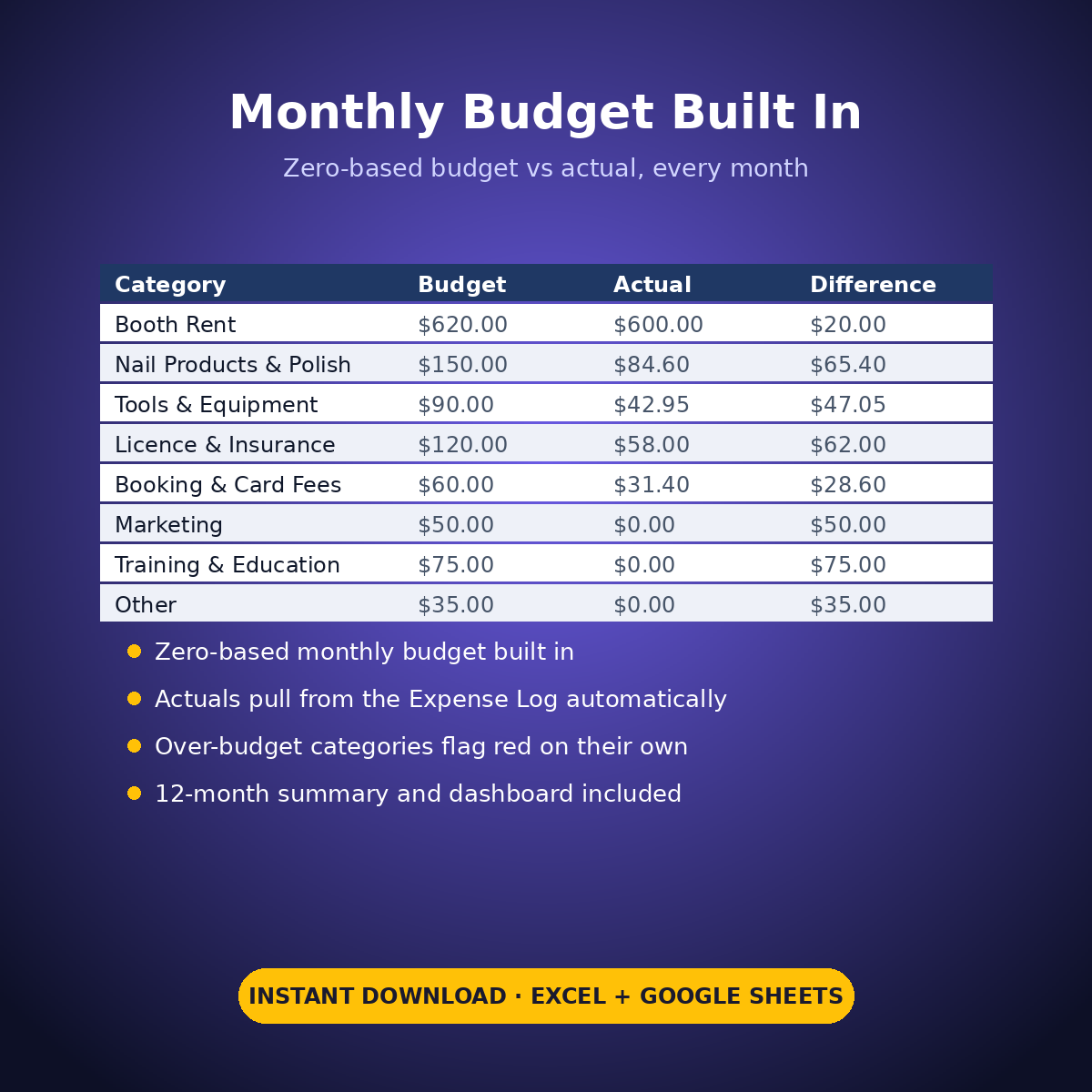
– Plus the standard Expense Log, zero-based Monthly Budget, Dashboard and Monthly Summary tabs
Every price, product cost, rent and fee in this workbook is an example setting you type — the sheet sets no prices and recommends nothing.
How it works: the seven tabs are Start Here (your settings + step-by-step), the two feature tabs, Expense Log, Monthly Budget (zero-based), Dashboard and Monthly Summary. Yellow cells are the only places you type — every yellow value is your own entry. Formula cells are locked (password: sheetdaily, disclosed on the Start Here tab) and every formula is error-wrapped, so an untouched sheet reads blank instead of showing error codes. Instant download, ready for Excel and Google Sheets.
A note on the sample data: every price and date in this workbook is example data, typed in by hand to show you how the sheet behaves. Replace it with your own.


Reviews
There are no reviews yet.